The Imperial City of Hue — How to See It Properly
Plenty of visitors walk the Imperial City for forty minutes and leave thinking they have seen it. In fact they have covered less than a third.
This page is translated from Vietnamese. Prices and opening hours are checked against Vietnamese sources — see the Vietnamese version for the most recent update.
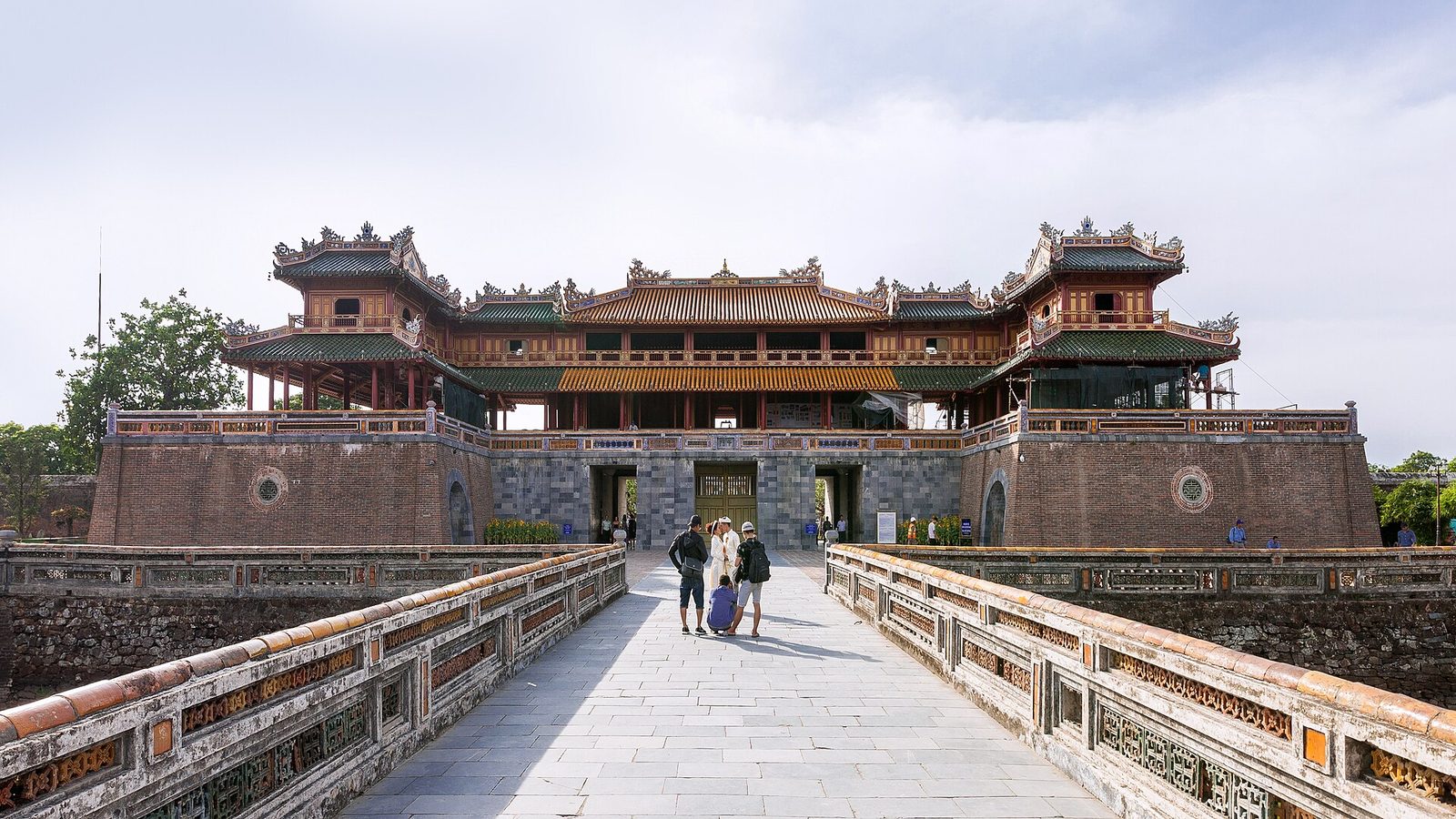
Photo: Supanut Arunoprayote · CC BY 4.0 · via Wikimedia Commons (cropped to 16:9 and resized)
Đại Nội is what people in Hue call the Imperial Enclosure and the Forbidden Purple City together — the two innermost rings of the Hue Citadel. This is where thirteen Nguyễn emperors worked, held court, honoured their ancestors and lived, from the early nineteenth century until 1945.
On 11 December 1993, the Complex of Hue Monuments was inscribed on the UNESCO World Heritage List as the world’s 410th site and Vietnam’s first. Since then Hue has added royal court music, woodblocks, imperial records, the literature inscribed on palace architecture, and most recently the reliefs cast on the Nine Dynastic Urns — making it the province with more UNESCO recognitions than any other in the country.
This article follows the order you will actually meet things after passing the gate, and points out the places people walk past without realising what they have missed.
Three walls inside one another

Newcomers tend to treat “Citadel”, “Imperial Enclosure” and “Đại Nội” as one thing. They are three rings inside one another, each with its own function.
The Citadel is the outer ring, about ten kilometres around, thick brick walls with a moat outside. Inside it is not only palaces but a whole city: houses, markets, warehouses, barracks. That is still true — ride through the citadel today and you pass streets, noodle shops and schools, not a silent monument.
The Imperial Enclosure is the middle ring, holding the ancestral temples and the halls of state. This is where the ticket office is.
The Forbidden Purple City is the innermost ring, the private quarters of the emperor and his family. “Purple” for the colour, “Forbidden” literally — an outsider found inside faced death.
Đại Nội means the two inner rings: the Imperial Enclosure plus the Forbidden Purple City.
How long it took to build. Emperor Gia Long had the site surveyed from 1803 and work began in 1805. Construction ran across two reigns and finished in 1832 under Minh Mạng — 27 years in total. The palace complex inside the Imperial Enclosure was not complete until 1833, with roughly 147 structures large and small.
That number is worth holding on to, because it shows that what you see today is a small fraction of what once stood.
The Flag Tower

Before the gate you pass the Flag Tower — a flagpole on three brick-and-stone tiers, dead centre on the citadel’s south face. It anchors the whole layout: stand at the Flag Tower and you look straight through the Meridian Gate to Thái Hoà Palace. The axis is deliberate.
The Flag Tower is not covered by the Imperial City ticket; photograph it freely from outside. Late afternoon light across the pole is the best of it.
The Nine Sacred Cannons

On either side of the Meridian Gate, under two roofed shelters, stand nine bronze cannons. Cast under Gia Long, each weighs more than ten tonnes.
The interesting part: they have never been fired. They are symbolic objects, not fighting weapons — nine pieces representing the four seasons and the five elements, each given a rank and a name of its own, as if they were people.
Most visitors walk straight through the gate without glancing sideways. Five minutes is all it takes.
The Meridian Gate

The Meridian Gate is the main entrance to the Imperial Enclosure, built in 1833 under Minh Mạng. Below is a U-shaped stone base with five passages; above sits the two-storey Five Phoenix Pavilion.
The five passages were not equal in status:
- The central passage was for the emperor alone
- The two flanking passages were for civil and military mandarins
- The two outermost were for soldiers, horses and elephants
Today you may enter through any of them, but knowing this makes walking through the middle one feel different.
The gate also witnessed a decisive moment in Vietnamese history: on the afternoon of 30 August 1945, Emperor Bảo Đại read his abdication from the Five Phoenix Pavilion, ending a monarchy that had lasted a thousand years.
Thai Hoa Palace

Through the Meridian Gate and across the Trung Đạo bridge over Thái Dịch lake, you reach the Great Rites courtyard and then Thái Hoà Palace.
This is the most important building in the Imperial Enclosure — where the emperor held court, was crowned, received birthday honours and met foreign envoys. It was built in 1805 under Gia Long.
Inside, the thing to look at is not the throne but the lacquered and gilded timber columns and the classical Chinese poems inlaid along the beams. The scheme is called one poem, one painting — a panel of verse alternating with a panel of imagery, and no panel repeats. It is exactly this body of poetry that UNESCO recognised as documentary heritage.
Just restored. Thái Hoà Palace went through a major restoration lasting three years and reopened on 23 November 2024. If you came to Hue before that and found it wrapped in sheeting, it is fully open now.
On the same day, Hue also broke ground on restoring Cần Chánh Palace — the largest building that once stood in the Forbidden Purple City. Come back in a few years and this area will look different.
The Forbidden Purple City

Past Thái Hoà Palace you enter the Forbidden Purple City. This is the part that disappoints first-time visitors most: it is largely foundations and grass.
The cause was war. In 1947 the area was heavily destroyed and many timber buildings burned to nothing. Of the 147 structures that once stood, only a few dozen were still standing by the end of the twentieth century.
Knowing that changes what you look for. Standing on the platform of Cần Chánh Palace, the thing to take in is not what is there but the size of what is gone: a stone base the area of a football pitch, which once carried an enormous timber hall.
The Temple of Generations

In the southwest corner of the Imperial Enclosure is the Thế Miếu complex, where the Nguyễn emperors are venerated. It holds the densest concentration of artefacts in the whole Imperial City, and it is also the part most people skip, because it sits off the main axis.
If time is short and you have to choose, choose this over wandering the courtyards for photographs.
The Nine Dynastic Urns

In the courtyard before Thế Miếu stand nine large bronze urns, cast from 1835 and completed in 1837 under Minh Mạng. Each corresponds to an emperor and weighs several tonnes.
Their value is not in the size but in the reliefs cast into their bodies. There are 162 in all, each with its own subject: rivers, mountains, seas, mountain passes, trees, flowers, birds, animals, boats, carts, weapons. Together they form a physical map of the country and its produce in the early nineteenth century, cast in bronze.
On 8 May 2024, at the 10th session of the UNESCO Memory of the World Committee for Asia and the Pacific, held in Mongolia, the reliefs on the Nine Dynastic Urns were listed as regional documentary heritage.
When you get here, do not just photograph all nine from a distance. Go up to one and look closely at the bronze — that is the part that was listed.
The Pavilion of Splendour

Directly behind the row of urns stands Hiển Lâm Các, a three-storey timber building and the tallest in the Imperial Enclosure. It was raised to honour those who served the dynasty.
There is a telling rule attached to it: no building in the citadel was permitted to stand taller than Hiển Lâm Các. Height here was rank, not engineering.
Truong Sanh Residence

The northern part of the Imperial Enclosure was the women’s quarter — for queen mothers and grand queen mothers. Trường Sanh and Diên Thọ residences are here.
This area feels completely different from the main axis: smaller in scale, full of trees, with ponds and rock gardens, closer to a Hue garden house than to a palace. It is also the emptiest part of the Imperial City, so if you want to sit down without being jostled, come here.
Duyet Thi Duong Theatre

Inside the Forbidden Purple City, Duyệt Thị Đường is the oldest surviving court theatre in Vietnam, built under Minh Mạng. It staged court opera and nhã nhạc, the royal court music UNESCO recognised in 2003 as a Masterpiece of the Oral and Intangible Heritage of Humanity.
Performances still run here during the day for visitors. If your schedule allows, this is worth the time: hearing nhã nhạc in the room it was written for is not the same as hearing a recording.
Kien Trung Palace

At the far end of the main axis, beyond the Forbidden Purple City, stands Kiến Trung Palace — architecturally unlike anything else here, a blend of Asian and European, built under Khải Định as the residence of that emperor and later of Bảo Đại.
It was destroyed in 1947 and lay in ruins for decades. The building was reconstructed and reopened in 2024. The Imperial City ticket now covers Kiến Trung; there is nothing extra to buy.
If you have read an older article saying “only the foundation of Kiến Trung remains”, that information is out of date.
Tickets, opening hours and when to come

Hue is wet from September to December, and in some years it rains steadily for a month. The Imperial City is mostly open courtyards, so rain ruins the visit.
January to April is cool and dry, and suits best. May to August is hot but dry, and workable if you avoid the middle of the day.
The Imperial City ticket in 2026 is 200,000₫ for adults and children over 12, the same rate for Vietnamese and foreign visitors. Children under 7 go free with an adult. The ticket includes the Museum of Royal Antiquities and Kiến Trung Palace; neither needs a separate purchase.
If you also plan to see the royal tombs, a combined ticket works out cheaper than buying separately: the Imperial City plus two tombs is 420,000₫, plus three tombs 530,000₫, and all sites together 600,000₫. A single tomb costs 150,000₫, so from three sites onwards the combined ticket wins. Combined tickets are valid for two days.
On time: a quick pass along the main axis takes about an hour and a half. Done properly, including Thế Miếu, Trường Sanh Residence and the Museum of Royal Antiquities, three hours is right.
Come at opening time in the morning or late in the afternoon. At midday the brick courtyards throw the heat back at you and there is almost no shade on the main axis.
Eating around the Imperial City

Inside the citadel walls it is still an ordinary neighbourhood, so there is no shortage of places to eat.
Bún bò Huế is the thing to have for breakfast before you go through the gate. Mụ Rơi at 48 Nguyễn Chí Diễu is right beside the Imperial City and cooks its broth over a wood fire.
Cơm hến, bánh bèo, bánh nậm and bánh lọc are found around Gia Hội and Đông Ba, about fifteen minutes’ walk across the bridge.
Đông Ba market is not far, and is where you buy Hue shrimp paste, tôm chua and mè xửng to take home.
How to combine it with the tombs

The Imperial City sits on the north bank of the Perfume River; the tombs are on the south bank and further southwest. A sensible split:
Morning — the Imperial City, because it opens early and takes the most energy. Afternoon — one or two tombs. Khải Định is small and quick, packed with porcelain inlay. Tự Đức is spacious and green, good for slow walking. Minh Mạng is the most balanced and the quietest, but the furthest away.
Do not try to squeeze three tombs and the Imperial City into one day. Do that and you will only have time to photograph each one before getting back in the car.
If you are based in Da Nang rather than Hue, there is a Hue day tour that covers the Imperial City, the tomb of Khải Định and Thiên Mụ Pagoda with the driving handled for you.
Places
- Thien Mu Pagoda — the Oldest Temple in HueFour hundred years on the bank of the Perfume River. In its courtyard stands the car that carried Thích Quảng Đức to Saigon in 1963.
- The Tomb of Khai Dinh — the Smallest and the Most ExpensiveEleven years to build, paid for by a 30% rise in land tax across the country. The most divisive of the Nguyen royal tombs — and the most sumptuous.
- The Tomb of Tu Duc — Where the Emperor Lived Before He Lay DownTu Duc used his own tomb as a retreat while he was alive. But building it caused an uprising, and to this day nobody is sure where he is buried.