Con Market — Da Nang's Street Food Headquarters
People in Da Nang do not go to Con Market to shop. They go to eat.
This page is translated from Vietnamese. Prices and opening hours are checked against Vietnamese sources — see the Vietnamese version for the most recent update.
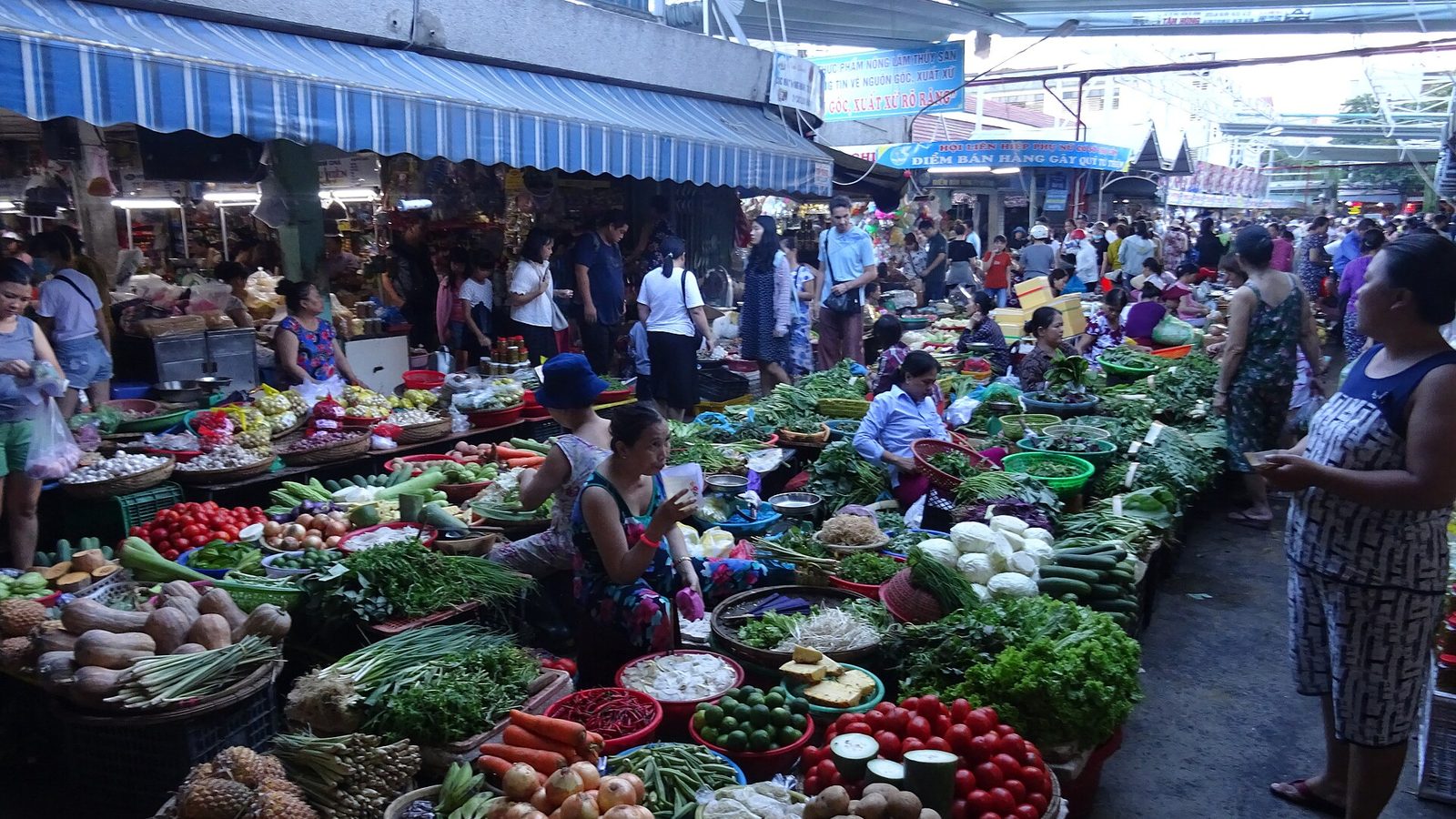
Photo: Christophe95 · CC BY-SA 4.0 · via Wikimedia Commons (cropped to 16:9 and resized)
Con Market is the largest market in Da Nang, at the corner of Hùng Vương and Ông Ích Khiêm streets, about a kilometre from Han Market.
The name comes from the old landscape: this used to be a raised mound in low-lying ground, and a market has stood on it since the 1940s.
How it differs from Han Market
Con Market serves local shoppers first. It is several times the size of Han Market, carries a wider range, is generally cheaper, and is also busier and harder to find your way around.
Han Market is compact and used to visitors, with pre-packaged specialities that are quick to buy.
If your aim is to eat and to see a working market, Con is clearly better. If you only need to buy gifts and move on, Han is more convenient.
The food section
The food section is what made Con Market’s name.
It sits on the ground floor: dozens of stalls side by side, each doing a few dishes. You sit in one place and order from several stalls at once.
The most commonly ordered:
- Ốc hút — snails stir-fried with lemongrass and chilli, sucked rather than picked out
- Bánh tráng trộn and bánh tráng kẹp — rice paper salad and grilled rice paper
- Chè in every variety, most often mixed chè and the jelly-and-pomegranate-seed version
- Bún mắm nêm — a Da Nang signature
- Mít trộn (young jackfruit salad) and gỏi khô bò (dried beef salad)
- Bánh bèo, bánh nậm, bánh lọc
Portions are small and cheap, so you can try many dishes in one sitting. It is the fastest way to sample a lot of Da Nang food at once.
Busiest from about 15:00 into the evening. Mornings are considerably quieter here.
What to buy
Beyond food, Con Market sells nearly everything: fresh produce, dried goods, fermented sauces, seasonings, clothing, household goods and fabric.
The dried goods and sauce section is where visitors usually stop — dried squid, dried fish, dried shrimp, various fermented sauces, beef jerky. Prices tend to be softer than at Han Market, but the goods less often carry full labelling, so ask carefully about origin and shelf life.
If you are flying home with fermented sauce, remember it cannot go in cabin baggage — it has to be checked, up to three litres or three kilos per person.
Things worth knowing
It gets very crowded in the late afternoon and at weekends. If you would rather not push through, come in the morning or early afternoon.
Watch your belongings. It is busy, so wear your bag in front and keep your phone out of a back pocket.
Park in the paid lots around the market rather than leaving a bike on the pavement.
Haggle over clothing, souvenirs and household goods. Food is priced as marked and not negotiated.
Getting there
Con Market is about a kilometre from Han Market, fifteen minutes on foot or a few minutes by road.
It is central enough to fit into any city itinerary. Snacks at Con Market in the late afternoon followed by the Dragon Bridge in the evening is a common way to arrange it.
See also Han Market.
Places
- Han Market — Where People in Da Nang Send You for SouvenirsAsk anyone in Da Nang where to buy food to take home and nine will say Han Market. The tenth will say Con Market.
- Nam O Fishing Village — Where Da Nang's Fish Sauce Comes FromAt the foot of the Hai Van Pass is a village that ferments anchovies in wooden vats for twelve months to draw off the first few drops.
- Ba Na Hills and the Golden Bridge — the Mountain That Was a French TownTwo stone hands holding up a golden ribbon of bridge — the image travelled the world. Few people know the mountain beneath it once held more than 200 French villas before the forest swallowed them.