Han Market — Where People in Da Nang Send You for Souvenirs
Ask anyone in Da Nang where to buy food to take home and nine will say Han Market. The tenth will say Con Market.
This page is translated from Vietnamese. Prices and opening hours are checked against Vietnamese sources — see the Vietnamese version for the most recent update.
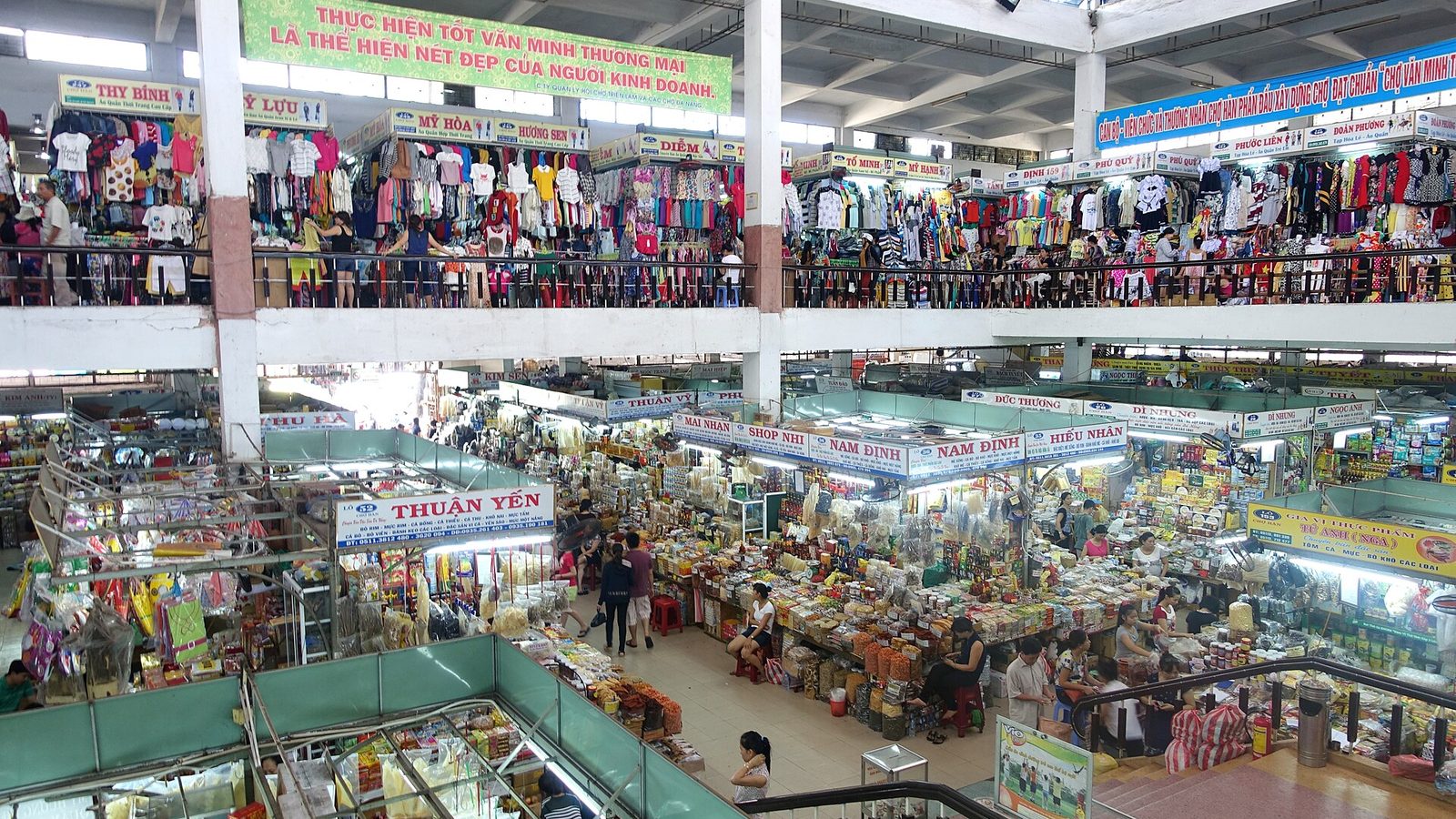
Han Market stands at the corner of Trần Phú and Hùng Vương streets, in the middle of the old Hải Châu district, a few hundred metres from the Dragon Bridge. It is Da Nang’s oldest central market and the first place most visitors head for when buying food to take home.
How the floors are laid out
Knowing the layout in advance saves a lot of wandering.
The ground floor is food and dried goods — fermented sauces, dried fish, candied squid, beef jerky, fermented shrimp, cakes and sweets. This is the floor most visitors want.
The first floor is fabric, clothing and souvenirs, plus quick-turnaround tailoring.
Food stalls are scattered on the ground floor and around the outside, selling chè, noodles, mì Quảng and snails.
The market runs roughly 06:00 to 19:00. Mornings are busy with local shoppers; afternoons bring more visitors.
The fermented sauce section

Fermented sauce — mắm — is what Han Market is best known for, and also the easiest thing to get wrong if you do not know what to look at.
The usual types: mắm ruốc (shrimp paste), mắm nêm (fermented anchovy sauce), mắm tôm chua (sour fermented shrimp), mắm cá cơm (whole anchovy), pickled vegetables, pickled scallions and chilli sauce.
When buying, keep these in mind:
- Taste before you buy. Every stall will let you; it is completely normal.
- Ask for the production and expiry dates and check the label on the jar rather than relying on what you are told.
- Plastic jars are light and do not break — better than glass if you are flying.
- Compare a few stalls before committing. The spread between stalls can be significant.
The Mắm Nhựt Hoàng stall at lot 103 is where our own stock comes from — you can buy directly there.
Flying home with fermented sauce

Plenty of people remember this only after they have bought.
Fermented sauce counts as a liquid and cannot go in cabin baggage. Checked in, the limit is three litres or three kilos per person. Beyond that you have to ship it.
At the point of sale, ask the seller to wrap it there and then — tape around the lid, two plastic bags tied tight. Back at the hotel, add bubble wrap or soft clothing and pack it in the middle of your case.
How haggling works here
Han Market does haggle, but it differs from tourist markets elsewhere: the margin is not large on labelled food products, because prices are fairly standard between stalls.
Souvenirs, clothing and fabric have far more room in them.
A sensible approach: ask at a few stalls first, then offer around seventy or eighty per cent of the opening price. Going much lower just wastes everyone’s time.
Eating at and around the market
Inside there is a snack section selling chè, bún mắm, mì Quảng and bánh bèo.
A few minutes’ walk away are places doing bánh tráng cuốn thịt heo (pork rolled in rice paper) and bún chả cá (fish cake noodle soup), plus the night food strip along Bạch Đằng street.
In the evening this area runs into the river bank and the Dragon Bridge, so it combines neatly: shopping late afternoon, dinner, then the bridge.
Han Market or Con Market
The two play different roles:
Han Market is central, compact, heavy on pre-packaged specialities and used to visitors. Convenient if you are short of time.
Con Market is much larger, generally cheaper, oriented towards local shoppers, and has a considerably stronger food section. Busier and harder to navigate.
If you are visiting one market to buy gifts, choose Han. If you want to eat and see a working market, choose Con.
Places
- Con Market — Da Nang's Street Food HeadquartersPeople in Da Nang do not go to Con Market to shop. They go to eat.
- Nam O Fishing Village — Where Da Nang's Fish Sauce Comes FromAt the foot of the Hai Van Pass is a village that ferments anchovies in wooden vats for twelve months to draw off the first few drops.
- Ba Na Hills and the Golden Bridge — the Mountain That Was a French TownTwo stone hands holding up a golden ribbon of bridge — the image travelled the world. Few people know the mountain beneath it once held more than 200 French villas before the forest swallowed them.