The Marble Mountains — Five Limestone Hills and a Stone Carving Village
Five limestone hills rising out of flat ground, named after the five elements. Inside them is a system of caves and temples.
This page is translated from Vietnamese. Prices and opening hours are checked against Vietnamese sources — see the Vietnamese version for the most recent update.
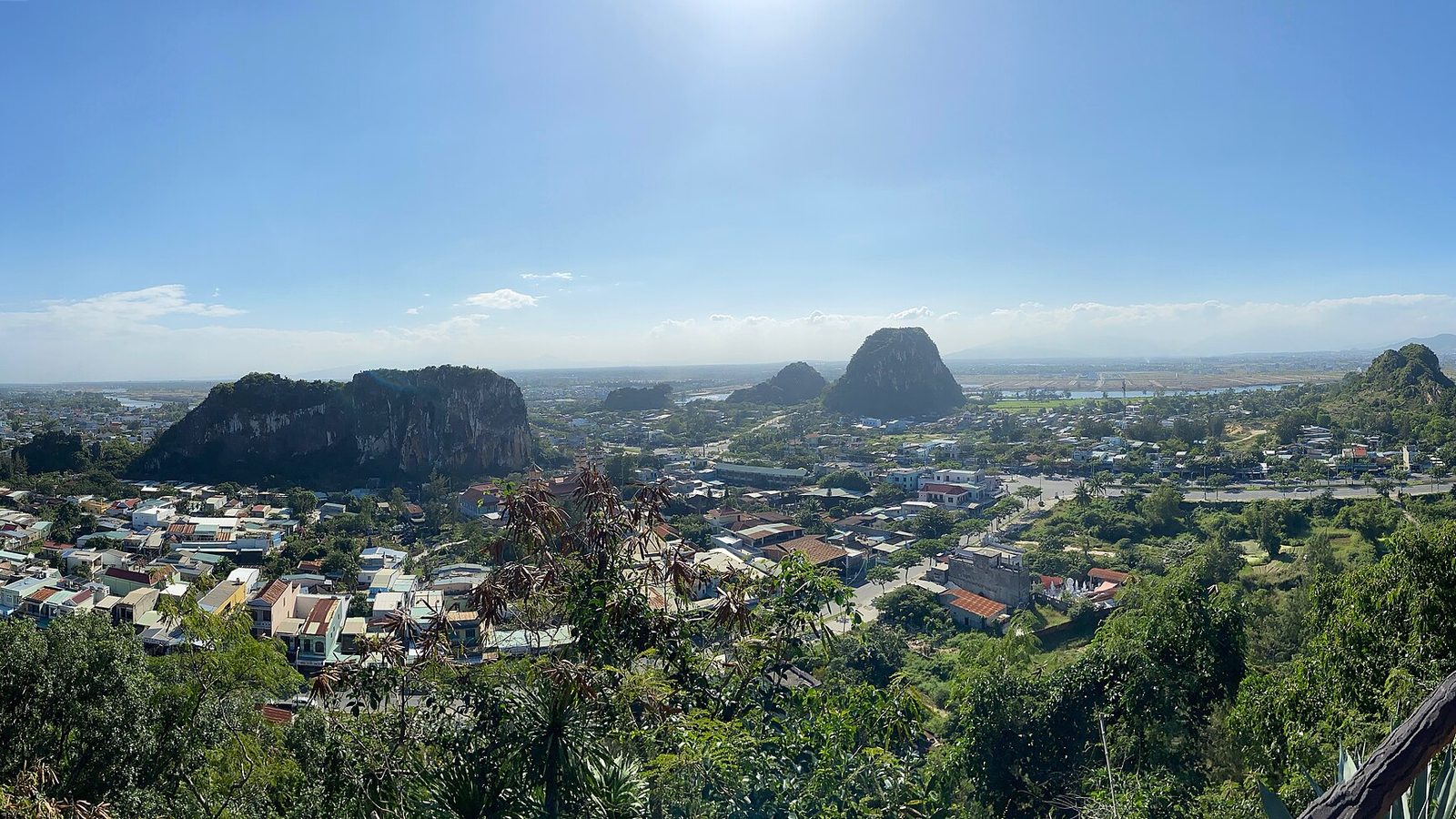
Photo: Kuroczynski · CC BY-SA 4.0 · via Wikimedia Commons (cropped to 16:9 and resized)
The Marble Mountains are a cluster of five limestone hills rising from flat sandy ground southeast of Da Nang, about 8km from the centre on the road to Hoi An.
They are named after the five elements: Kim Sơn (metal), Mộc Sơn (wood), Thuỷ Sơn (water), Hoả Sơn (fire) and Thổ Sơn (earth). Thuỷ Sơn is the largest, holds the most caves and temples, and is the only one most visitors climb.

What sets this place apart from Da Nang’s other sights: it is a mountain, a cave system and a temple complex all at once, and inside the caves are rock inscriptions listed by UNESCO. Four things stacked on top of each other, in an area you can walk in about two hours.
Limestone in the middle of a sand plain
Geologically, these five hills are limestone and marble left behind — the hard core that resisted erosion while the surrounding land wore down into coastal plain. Groundwater hollowed them out from the inside, creating the caves you walk into today.
That marble is exactly what gave rise to the stone carving trade at the foot of the hills. But decades of quarrying ate into the mountains, so taking stone from the site is now banned; the village works with stone brought in from elsewhere.
The rock inscriptions — the best thing here, and the least noticed
On the cliff faces and inside the caves of Thuỷ Sơn is a system of ma nhai inscriptions: Chinese and Nôm characters carved directly into the rock, made between the seventeenth and twentieth centuries, 78 texts in total.
In November 2022, at the 9th session of the UNESCO Memory of the World Committee for Asia and the Pacific, held in Korea, the Marble Mountains rock inscriptions were listed as a regional documentary heritage.
The content varies widely: poems by kings and mandarins, records of temple restorations, notes left by pilgrims. Taken together they form an archive of three centuries of religious and cultural life in this region, cut straight into stone.
Most visitors walk past without knowing. If you remember one thing here, remember to look up at the rock face.
The main caves

Huyền Không cave is the largest and the most striking. Natural openings in the roof send light down in columns — around midday on a sunny day the shafts are clearest. Inside there is a main altar and a number of statues.
Tàng Chơn cave sits behind Linh Ứng Pagoda and consists of several small connected chambers, darker and much quieter.
Âm Phủ cave is separate, a folk depiction of the underworld, with sections where you have to climb and squeeze through. It has its own ticket, and it is the part children like best.
Temples and viewpoints
Thuỷ Sơn holds two old temples: Tam Thai on the west side and Linh Ứng on the east. Both date from the Nguyễn dynasty and were restored under Emperor Minh Mạng.
Two viewpoints worth the detour:
- Vọng Giang Đài, looking towards the river and the western mountains
- Vọng Hải Đài, looking out over Non Nước beach and the Sơn Trà peninsula
Late afternoon at Vọng Hải Đài is the most comfortable time — the sun has softened and you can follow the coastline all the way towards Hoi An.
The Non Nuoc stone village
At the foot of the hills is the Non Nước stone carving village, several centuries old. A whole street of workshops displays statues from hand-sized to life-sized.
If you are buying a souvenir, choose something small. A medium statue already weighs tens of kilos, shipping often costs more than the piece, and carrying it onto a plane is close to impossible. This is also a place to haggle.
Stairs or lift
There are two ways up Thuỷ Sơn:
On foot, about 150 stone steps. The steps are uneven and slippery in damp weather, but you pass alcoves and inscribed rock faces the lift skips.
By lift, ticketed separately, going straight to the middle of the hill. It suits older visitors, small children, or the middle of the day.
Even with the lift there is still plenty of walking and climbing on top. Wear shoes with grip, not flip-flops.
When to go and how long it takes
Doing the caves and temples properly takes about two hours. A quick pass takes one.
Early morning or late afternoon work best. At midday the stone radiates heat and the open steps have no shade — unless you want the light shafts in Huyền Không cave, which are at their clearest around noon.
The dry season, February to August, is comfortable. In the rainy season, September to December, the steps get slippery and need care.
Combining it with other places
The Marble Mountains sit exactly halfway along the Da Nang – Hoi An road, so the natural move is to fit them into the morning on the way down to Hoi An, or the afternoon on the way back.
Non Nước beach is nearby and walkable — wider and emptier than Mỹ Khê.
They also appear as a stop on the Hoi An afternoon tour and on the two-day and three-day Da Nang itineraries.
Places
- Nam O Fishing Village — Where Da Nang's Fish Sauce Comes FromAt the foot of the Hai Van Pass is a village that ferments anchovies in wooden vats for twelve months to draw off the first few drops.
- Han Market — Where People in Da Nang Send You for SouvenirsAsk anyone in Da Nang where to buy food to take home and nine will say Han Market. The tenth will say Con Market.
- Con Market — Da Nang's Street Food HeadquartersPeople in Da Nang do not go to Con Market to shop. They go to eat.